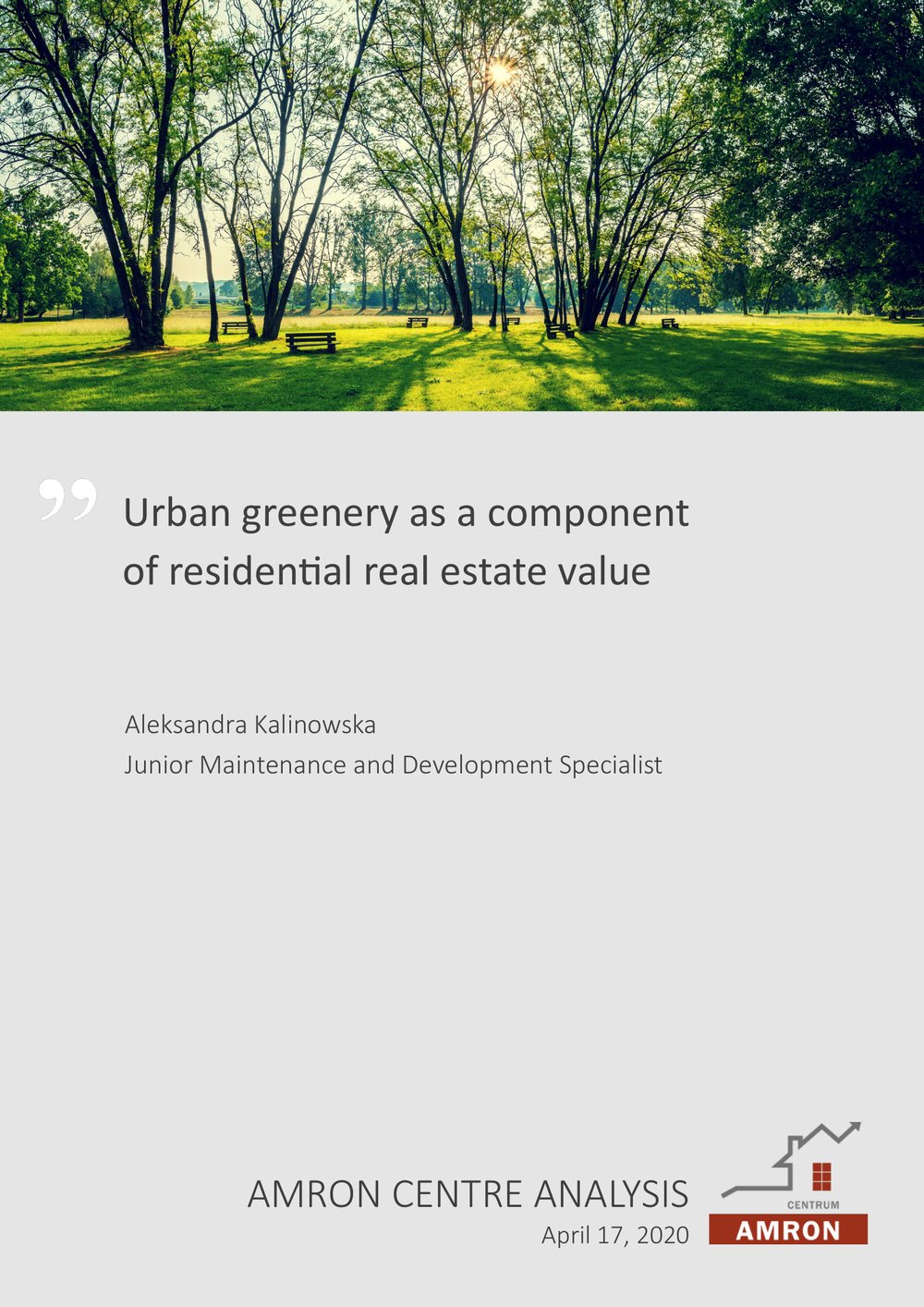
Urban greenery as a component of residential real estate value

Nowadays greenery in the city is being referred to as ‘green infrastructure’. It performs an undeniable climate function and it has become very valuable and desirable aspect in humans life. Among other things, greenery is important when choosing the location of a new flat. Building in a compact way, even at the expense of green areas is not uncommon in Poland. The undeniable fact is that the proximity of greenery is what makes the location of the apartment attractive. How that affects the prices?

DIAGRAM 1. AVERAGE PRICES OF FLATS NEAR GREEN AREAS AND AVERAGE PRICES IN DISTRICT (PLN/sqm)

200417_Urban_greenery_as_a_component_of_residential_real_estate_value_AK_rId7

source: own elaboration on the basis of data from AMRON Centre (data from 2017-2020)

Larger green areas can be easily found in most cities. These areas are eagerly used for recreational purposes, doing sports or just for relaxation. The presence of the park significantly increases the attractiveness of the location, thus the prices of apartments. Chart 1 shows the average transaction prices of residential premises in three districts of Warsaw and the prices of apartments near two parks and the forest. The average price of apartments at Gwiaździsta street, where Kępa Potocka Park is located, are 13% higher than the average price in Bielany district. A similar price distribution can be seen near the Skaryszewski Park, where apartments are more expensive by up to 700 PLN per square meter, compared to average price for the Praga Południe district. Slightly larger compared to the rest, but the highest price difference, was found for properties located near the Kabaty Forest in the Ursynów district, where apartments are up to 14% more expensive. Therefore, it may be estimated that apartments located close to large-scale green areas increases the value of real estate by an average of 12%. Windows with a view of a beautiful park and the possibility of going for a longer walk in the midst of greenery is visibly important asset for which you have to pay.

What might be the trend in the future? Will be apartments in such location more desirable?

The building land earmarked for housing construction is significantly limited in cities. The number of investment areas, especially in attractive locations, is negligible. A noticeable tendency among developers is to maximise intensification of development. As a result, greenery in most residential development is limited to areas of lawns, which have rather an aesthetic function. Thus, it complies with the provision of the minimum biologically active surface, but it does not affect residents’ quality of life. The effects of disregarding functions of vegetation are becoming more and more obvious. The growing number of multi-family buildings of this standard results in an increase requirement for apartments located closer to green areas.

The benefits of greenery in cities are enormous. Research conducted by J.G. Migneron confirms that greenery absorbs noise in a similar way to sound-absorbing materials used in construction. Coniferous trees, which have a large foliage size, turned out to be the largest sound absorption coefficient. Low grass type (0.6 meters high) or shrubs also have high noise attenuation properties. More importantly, it has been proven that the width of green has a clear impact on reducing high frequency noise. That is why it is so important to design green belts and not to limit it to individual pieces. Providing greenery in the city, not only helps to reduce noise, but also guarantees better ventilation. The air flowing from the vegetation is enriched with oxygen and is free of harmful gases such as SO2, H2S, etc. Indirectly the vegetation also helps fight with suspended dust. This is even more important because pollution standards in Polish cities are constantly exceeded, even by several hundred percent. Greenery also helps to reduce the temperature amplitude by absorbing heat during the day. This is important in the summer, when the air overheats, which reduces quality of life. Greenery in the urban environment also has an important role in improving the water management system. Water retained by the plants relieves the sewage system and eliminates the need for expensive irrigation systems. Therefore, we should plan and protect greenery in cities. Yet there are cases of cutting down trees or shrubs and turning squares into concrete deserts. One of many examples is the square in Skierniewice, which has been transformed from a public green area into a concrete square (Picture 1.). Then, it is not a surprise that this area lost its climate function. Furthermore, flats located near this square can be considered now less attractive despite the location in city centre. Thus the actions described above can reduce prices of existing flats in great locations.

PICTURE 1. MARKET SQUARE IN SKIERNIEWICE BEFORE AND NOWADAYS

source: miastojestnasze.org

Urban greenery is not limited to areas such as parks. It includes green spaces, botanic gardens, allotment gardens, cemeteries, flowerbeds and more. In addition to the undeniable climate function, greenery has aesthetic, recreational and socio-educational functions. Climate change is an increasingly noticeable problem in everyone’s life. Scientists’ warnings about the effects of climate change increase our awareness of ecological life. This leads to changes in lifestyle, including the desire to spend time closer to nature. Thus, people will be more eager to choose housing estates nearby green areas.

According to UN forecasts, in 2025, 60% of the world’s population will live in large urban agglomerations, and 80% in cities with more than 20,000 inhabitants. Increased number of population is not going to translate into an increased number of greenery. With the increase in population, there is an increase in demand on the housing market. Lack of relevant legal procedures in Poland makes it impossible to manage rational land use. This will lead to progressive decline of the green areas. Furthermore, the effects of these changes may include an increase in the prices of apartments located close to parks, forests or even smaller green areas.

On the other hand, the natural dimension in the concept of urban development is taken into account since antiquity. Over the ages, the idea of ​​greenery in the spatial structure has evolved, however it has always been an integral element. It is not surprising then, that urban green policy is included in the urban development strategy. One of the most important documents for sustainable development is the 2030 Agenda adopted by all members of UN. Document has many major goals including strengthening resilience and adaptive capacity to climate-related hazards and natural disasters. This for sure challenge us to take the necessary steps to improve condition of the cities. Today, this postulate is guided by many local government initiatives. In addition, hundreds of projects and platforms operate to conduct comprehensive, innovative, promotional and educational activities to prevent climate change. One of the organisations cooperating within the platform is the Polish Association of Developers, at which operates a multidisciplinary team of Eco Avengers experts. They are the authors of an eco-guide for developers. The goal is to popularise knowledge and promote proven ecological activities on new investments throughout Poland. The Eco Avengers team is also the author of the Last Chance Decalogue – the Ten Commandments for developers with ecological cross-sectional solutions for each new investment. Among the recommended solutions that should be implemented, they are calling to collect rainwater, planting of greenery or sorting construction waste to help the environment as much as possible.

Conclusions

In the face of increasing population and urbanisation of cities, green areas are decreasing. Thus, the presence of greenery in close proximity to residential buildings is becoming more and more important. At the same time, the awareness of sustainable urban development is growing not only among urban activists, but also among local government officials and entrepreneurs, who have a huge impact on the shape and appearance of our cities and the quality of life of their residents. Therefore it can be assumed that flats located near such areas will be more and more desirable and their prices may rise.

Aleksandra Kalinowska
Junior Maintenance and Development Specialist

Technical Conditions 2021- new guidelines for energy saving and thermal insulation of buildings

In recent discussion about the future of construction and development market and especially the factors affecting the increase of the housing construction costs, it is the new regulation on Technical Conditions that seems to be pointed on more and more frequently. Technical Conditions 2021 (in short ‘WT 2021’) are the new requirements for newly constructed buildings, which will come into force from the beginning of 2021.

The legal basis for introduced changes is the Regulation of the Ministry of Transport, Construction and Maritime Economy from the 5th of July 2013, amending former regulation on the technical conditions to be met by buildings and their location. This regulation implements into Polish law the provisions of the Directive 2010/31/EU of the European Parliament and the Council of 19 May 2010 on the energy performance of buildings (Official Journal of the EU L 153 from 18.06.2010, p. 13). WT 2021 is the third amendment, after two previous that came into force in 2014 and 2017, introducing much stricter criteria regarding energy efficiency of buildings. Such a periodic updates of regulations are primarily aimed at using and implementing new opportunities resulting from technological progress in the construction and building materials industries.

The new requirements will apply primarily, but not only to those investors, who will obtain a building permit and start the investment after December 31 this year. Moreover, unfinished projects (in this case the formal closing of the construction process is considered as the moment of completion), will have to be adapted to the requirements of the new provisions. Furthermore, this requirement will also apply to buildings already in use if expanded or modernized.

The new technical conditions introduce changes in two main areas – required minimum thermal insulation of building partitions and the determination of the maximum permissible level of building demand for non-renewable primary energy used for heating and hot water preparation, as well as ventilation and cooling.

The level of thermal insulation of building partitions is expressed by the U coefficient, determining the amount of heat permeating through a specific unit of the partition surface at a given difference of temperature on it’s both sides. Therefore, the lower value of the indicator, the barrier isolates better. WT 2021 regulation introduces increased requirements for the insulation of external walls (from the current UC (max) = 0.23 to 0.20), roofs, flat roofs and ceilings under unheated attics or over passages (from 0.18 to 0.15), windows, balcony doors, transparent non-open surfaces (from 1.1 to 0.9) and roof windows (from 1.3 to 1.1) and external doors (1.5 to 1.3). This, of course, forces investors to use more expensive building materials of better parameters, what raises controversy regarding the profitability of the adopted solutions. According to some estimates, the cost of some building materials will increase even by more than 30%. However, other calculations indicate that despite this, the building cost of entire investment will increase by just a few percent. Of course measurable benefits resulting from the use of energy-saving technologies, including above all incomparably lower costs of building maintenance should also be remembered here.

WT 2021 also introduces a new level of acceptable building demand for non-renewable primary energy. For single-family buildings it has been reduced from the current level of 95 to 70 kWh / (m2·year) and in case of multi-family buildings from 85 to 65 kWh / (m2·year). Primary energy is the sum of the energy directly used for heating, hot water preparation, ventilation and cooling of the building (final energy) and the amount of energy used to produce and deliver it. The level of primary energy results then not only from the direct energy demand of our building, but also from the type of used fuel or the heating method.

Therefore, while in case of changes in requirements for the insulation of building partitions, estimating differences in construction costs is relatively simple, which this makes sense, of course, only for a specific investment, in case of lowering the level of acceptable building demand for non-renewable primary energy it is a more complex issue. Based on a very interesting analysis of the possibility of meeting new requirements by a multi-family building, entitled ‘Multi-family buildings according to the requirements of WT 2021’ by dr inż. Szymon Firląg and mgr inż. Weronika Górecka from the Warsaw University of Technology it can be concluded that the level of additional costs associated with necessary adaptations of the investment to the requirements of WT 2021 may depend on two main factors. Firstly, the availability of individual energy sources in a specific location, including above all the availability of the municipal heating system, and secondly, it’s efficiency. Interestingly, in some cities, for the adopted example building, even connecting to the municipal heating network would guarantee meeting the requirements of WT 2021 (in terms of demand for primary energy). This would be the case of Gdansk, Bialystok, Zielona Gora, Lodz, Lublin, Katowice and Rzeszow. In the few largest Polish agglomerations however (i.a. Cracow, Wroclaw, Poznan) it would be difficult even with the use of additional renewable energy sources.

There is therefore no question that the new technical conditions will affect the level of construction costs of all types of buildings, both residential and non-residential. However, this impact will vary considerably depending on the type and location of the investment, and any attempts to generalize its level do not seem to make sense. Similarly, simple profitability calculations of using particular, more expensive building materials and negating on that basis the legitimacy of the adopted solutions make no sense either. At a time of scientific consensus on human impact on climate change, new requirements should rather be assessed as indispensable. Additional costs in this context seem secondary.

Jerzy Ptaszyński
Research and Market Service Director

Factors of housing prices changes on the primary market in 2020

Exceeding the historical maximum nominalhousing prices in most of the largest Polish cities has triggered, by simple analogies to the previous business cycle peak, expectations for their sharp falls, speculation about the rise of the speculative bubble and the prospects of its burst. Current market situation is however decisively different from the one we dealt with almost twelve years ago. Prices in real terms (taking inflation into account) are not high, interest rates are much lower and the level of wages is much higher. Considering these basic differences, the availability of apartments is still much higher than then, even before the peak of price increases. Moreover, the behaviour of today’s apartment buyers have little to do with often irrational market participants’ decisions observed more than a decade ago. Expectations of a rapid collapse of the housing market and dramatic declines in housing prices seem premature, especially when the situation on the primary market in near future will be shaped by a number of cost factors generating pressure on prices increases. So what will be the key factors from the perspective of price formation on the primary housing market?

1. Continuing high demand for flats

Despite expected or even already observed economic slowdown in the largest European economies and the national economy, the number of transactions concluded on the real estate market does not decrease. At a low level of interest rates, real estate will remain one of the most attractive investment objects, which in the situation of uncertainty in the economy and rising inflation will also stimulate further purchases.

2. Increase in electricity costs

Construction alone does not belong to the high electricity-consuming industries, with a high share of electricity cost in added value created in the sector. It would seem then, that the increase in electricity prices should not have a significant impact on the cost of housing construction. However, two reservations should be made here. Firstly, unlike some much more energy-intensive sectors of the economy, electricity consumption in construction is very inflexible, making any adjustments and savings very unlikely.That means that the increase in electricity costs is passed on to the total costs of building apartments virtually in a 1: 1 ratio. Secondly, increases in electricity prices will cause a significant increase in production costs of key building materials for housing, including primarily cement and steel, production of which is energy-consuming. Rising electricity prices have and will continue to have a significant impact on construction costs and, consequently, housing prices.

3. Situation on the labour market and opening of the German labour market for nonEU citizens

According to estimations, German economy needs between 800000 and 1.5 million employees. It is true that those needs are mainly associated with highly qualified employees, but there is also lack of employees in German construction sector. It is rather unlikely that the relocation of Ukrainian employeesfrom Poland to Germany will happen immediately and on massive scale, so it can be expected that the impact on the Polish labour market, including the construction sector, will probably be postponed. It seems however, that the outflow of some Ukrainians working in construction industry and simultaneous increase in wage expectations of those, who decide to stay in Poland, should be taken into account even this year. In subsequent years, problems with qualified employees recruitment will be overlapped by additional burdens for companies operating in the industry, mainly related to increase in the minimum wage (this year’s increase was 15%), as well as social security contributions for employees conducting business activity.

4. Increase in land prices for multi-family construction

Demand for land for multi-family housing by developers remains high. This is a consequence of both the prosperity on the housing market and the willingness to secure the continuity of development companies and to launch new projects before the WT2021 standard enters into force. Meanwhile, land supply in the largest Polish agglomerations is very limited. The situation is not improved either by legal changes made in the last few years or by “freezing” of land for “Flat Plus” Programme projects, that have been ongoing for several years. Consistently deteriorating financial situation of local governments, which is a result of the policy pursued by the state, will also affect the market for construction land in the future. It can be expected that the pace of preparing and adopting local spatial development plans by municipalities, far from satisfactory in previous years, will even slow down.

5. Amendment to the development act

Work has been continued on the amendment to the development act, which is to introduce – following the model adopted in the banking industry – the Development Guarantee Fund. The fund is assumed to accumulate means in the event of developers’ bankruptcy, guaranteeing that buyers of apartments get back all the invested money. The amount of contribution assumed by developers remains a contentious issue – a maximum of 3% of payments made by buyers to open escrow accounts and a maximum of 0.6% of payments made to closed accounts. The final amount of contributions is to be variable and determined by administrative decision. The maximum level specified in the bill can be however assessed as very high. If the amended provisions finally come into force, it should be expected that all additional costs will be passed on to the buyers by including them into the price of flats. As experience with the introduction of sectoral cost factors shows (e.g. the consequences of the introduction of the bank tax in 2016), this would be another very important factor affecting the increase in housing prices on the primary market.

Summary

Given the recent events, we can also imagine an alternative scenario (in fact it seems more and more real), in which, as a result of spreading coronavirus epidemic, economic growth in Poland will significantly slow down or the economy will even enter recession. In such a situation, we would expect a significant reduction in consumption and at the same time a slowdown in investments, including those made by private persons on the real estate market. However, even if this negative scenario materializes, it seems that the consequences on the housing market would be seen rather in the form of temporary freezing turnover and change in its structure than dramatic price drops. A similar situation has already occurred after the bankruptcy of Lehman Brothers in September 2008.

Therefore, in the event of a moderate economic slowdown, on the secondary market we may be witnessing a reduced tempo of prices growth or even their fall. On the primary market, however, such scenario is hard to be expected. Even in a situation of falling demand for flats, we should rather expect a reduction of the scale of development production than a significant price correction.

Jerzy Ptaszyński
Research and Market Service Director

2019 on the six largest Polish residential property markets

2019 was the second-best year in the history of the developer market in terms of the number of sales of new flats, which amounted to 65.4 thousand. This is only 10% less than in the record year 2017, when the ‘Flat for Youth’ Programme was eligible for application. The annual increase in property prices did not exceed 10%. Despite the price increase, demand was at a high level. The six largest Polish cities were analysed, based on the latest data published by the National Bank of Poland.

CHART 1. AVERAGE APARTMENT PRICES PER SQ.M. IN THE SIX LARGEST POLISH CITIES ON THE PRIMARY MARKET (Q4, 2018 – Q4, 2019)

Source: own source on the basis of NBP reports

CHART 2. AVERAGE APARTMENT PRICES PER SQ.M. IN THE SIX LARGEST POLISH CITIES ON THE SECONDARY MARKET (Q4, 2018 – Q4, 2019)

Source: own source on the basis of NBP reports

The first quarter of 2019 was characterized by high activity on the market – demand remained at the level of the previous quarter. Great interest was noticeable both on the primary and secondary market. According to the National Bank of Poland (NBP) reports, the highest increase in apartment prices on the primary market in relation to the previous quarter was recorded for Gdansk (increase by 4.37%) and the lowest for Poznan (increase by 0.48%). The situation on the secondary market was different: a decrease in apartment prices was noticeable for three cities. The greatest decrease was recorded for Krakow (3.26%), while the largest increase was recorded on the Lodz real estate market (3.38%).

In the second quarter, an increase in property prices was still observed. There was a shortage of flats on the developer market, which affected the increased residential demand on the secondary market. Price increases were higher than on the primary market. An example is Gdansk, where the price increase on the primary market amounted to 0.31% compared to the previous quarter, while on the secondary market prices increased by 6.42%. The only price drop was recorded on the Warsaw secondary market (down by 3.24%).

The third quarter of 2019 did not differ from the previous ones – there was still a noticeable increase in the prices of residential units. The highest increase was observed on the Wroclaw secondary market (5.80% increase). The only city where there was a drop in prices on the secondary market was Gdansk (down by 1.74%).

In the fourth quarter, the upward trend was maintained. The highest increase in the average price per meter on the primary market was observed in Krakow – 5.87% in relation to the previous quarter. A slight decrease was recorded on the Wroclaw market (decrease by 0.35%). In 2019 the prices of apartments from secondary market reached their maximum values in the fourth quarter. The highest price increase was recorded in Gdansk (up by 7.56%) and in Wroclaw (up by 6.68%).

CHART 3. NUMBER OF COMPLETED APARTMENTS (Q4, 2018 – Q3, 2019)

Source: own source on the basis of CSO (GUS) reports

From January to September 2019, 43 572 apartments were completed in the cities covered by the analysis. The largest number of apartments put on market (15 160) was in Warsaw. The second place was taken by Krakow with 9 306 apartments, followed by Wroclaw with 7 529 apartments. The most dynamic situation occurred in Gdansk. In the first quarter of 2019, the number of completed apartments decreased by 54% compared to the previous quarter, while in the second quarter this number increased by 76%.

CHART 4. NUMBER OF BUILDING PERMITS ISSUED (Q4, 2018 – Q3, 2019)

Source: own source on the basis of CSO (GUS) reports

In the analysed period, 50 016 building permits were issued for the six largest Polish cities. The largest number of permits, as many as 15 884, were issued in Warsaw. The most productive was the second quarter (18 873) in terms of the number of permits issued. The greatest increase was recorded for Krakow – the number of permits issued in the third quarter was over twice as high as in the second quarter.

CHART 5. NUMBER OF APARTMENTS UNDER CONSTRUCTION (Q4, 2018 – Q3 2019)

Source: own source on the basis of CSO (GUS) reports

For the cities included in the analysis, in 2019 the construction of 62 843 apartments had started. Most investments were commenced in the third quarter (18 074) and the least in the second quarter (12 676). Obviously, the largest number of apartments under construction was in Warsaw – 22 259, which constituted 35% of all newly stated constructions. In turn, the largest increase in the number of apartments under construction was recorded in Lodz in the first quarter of 2019. In comparison with the fourth quarter of 2018, this number more than doubled.

The year 2019 showed that the residential market is still in a high phase of activity. Poles willingly bought apartments not only for their own needs, but also to use them for rent. This situation was influenced by low interest rates and, consequently, low loan instalments. Despite the constant increase in prices caused by high construction costs, the demand remained at a constant, high level.

Dominika Gocalińska
Junior Customer Relations Specialist

The size of the rent market in Poland

Almost every twentieth adult in Poland lives in a flat rented at market prices. It is almost twice as much as 8 years ago. Nevertheless, we are still far from the European leaders. For example, in Switzerland half of the citizens rent apartments at market prices and in Germany or Denmark this percentage is around 40%.

CHART 1. SIZE AND STRUCTURE OF THE RENTAL MARKET IN EUROPE IN 2018 (PERCENTAGE OF THE POPULATION)

source: own study based on EUROSTAT and OECD data

The conservative attitude towards renting in Poland is determined by historical and sociological factors and our country is not an exception in this matter. In none of the former Eastern Bloc countries the percentage of landlords at market prices does not exceed 7% (the highest is in Latvia – 6.9% and in Slovakia – 6.8%). Owning an apartment appears as an indicator of a certain social status. Strong attachment to property rights is also a manifestation of the income effect materializing on the Polish real estate market. Real estate is still identified as the most secure asset, which in their particular dimension constitute a reliable, accumulated lifetime investment of capital. In Poland, the capital market is not as developed as in Western Europe, what implies the lack of a common alternative to accumulating and investing savings. In other words, owning a flat is on one hand always seen as a privilege and constitutes the fulfilment of fundamental needs, on the other hand it is a form of wealth accumulation, which is mainly the result of lack of universal investment opportunities on the securities market.

Low labour mobility of Poles is another demand factor that affects the reluctance to rent a flat. According to the Central Statistical Office data, the last positive balance of internal migration from city to city was in 2000 – precisely after a decade of political changes. Poles do not migrate internally, because if they decide to leave for work, then it will be abroad, and second of all the situation on the labour market does not require it. The place of work is primarily determined by the place of residence, not contrariwise.

Although the percentage of adults renting an apartment at market prices in Poland is relatively small, we have been observing an upward trend in this area for last several years. It is related to the ongoing demographic processes (the ‘baby boom’ generation from the first half of the 1990’s is increasingly emphasizing the need for spatial independence) and the slow change in attitude towards renting an apartment. However, supply factors that make up the rental market, play a key role in this case. The period of low interest rates has in fact created a trend in Poland to buy apartments for purely investment purposes – volume of apartments for rent is steadily increasing, which results in competition on the market both in terms of price (rent rates are flattening) and quality (flats on rental market are in increasingly better technical and functional condition). Establishment of institutional entities offering flats for rent is also significant, the largest of which is the state Housing Rental Fund. Also, more and more development companies are building for rent. Institutional rent is characterized by greater transparency and is assumed to balance the legal interests of tenants and landlords – these are the factors that increase interest in rent among Poles.

CHART 2. THE STRUCTURE AND DYNAMICS OF APARTMENT RENTAL AND THE INCREASE IN COMMUNAL AND RENT APARTMENTS IN POLAND IN 2010 – 2018

source: own study based on EUROSTAT and OECD data

Noteworthy is also the decreasing number of people using various forms of subsidized rental, meaning mostly communal, social or socio-rent apartments – the percentage of people covered by this form of support has decreased over the last 8 years by more than 4%. Economic growth and a very good situation on the labour market in recent years have definitively encouraged some rent tenants interested in better housing standards to fuel the open rental market. However, correlation between the percentage of people living in communal and rental premises with the number of newly commissioned premises of this type cannot be missed. The number of new social and rental premises decreases every year. In 2010, 3 506 communal premises were commissioned, while eight years later it was only 1 863. This trend should reverse slightly in the coming years – BGK will allocate PLN 1.3 billion in the framework of the Social Rent Construction Program in the perspective of 2019 – 2025. In addition, a program of non-returnable municipal and social housing support from the Subsidy Fund was launched last year. In 2019 – 2020, PLN 500 million will be allocated for this purpose annually, and in 2021 – 2025 this amount will double.

SUMMARY

More and more Poles decide to rent a flat on the open market, although in this term we differ significantly from the European average. Structural changes that take place on the rent market will cause an increase in Poles’ interest in this form of accomodation in the coming years. The base of municipal and rent apartments should also increase. However, it does not mean a rapid change in the structure of dwellings ownership – the rental preference will increase along with the progressing demographic changes and its dynamics will largely be determined by institutional solutions and the creation of the supply of apartments for rent of an appropriate standard.

Łukasz Stępkowski
Maintenance and Development Specialist

Are dwelling prices breaking records?

We have been observed slight, systematic increases in dwellings prices in the largest Polish cities for several years, but in recent quarters we have noted an acceleration of this trend, when quarterly increases in both primary and secondary markets have amounted to even 5 – 6%. In Q3 2019 the average transaction prices of 1 sqm of floor area of dwellings in the largest Polish agglomerations increased by approx. 4% – this phenomenon was observed not only in the capital city, but also in Bialystok or Katowice agglomeration. In relation to the same period of 2018, recorded increases amounted to approx. 7 – 10%, and since the beginning of 2013, average prices in most of the analysed cities increased by approx. 20 – 25%, while in Lodz and Gdansk increases by almost 40% were recorded.

CHART 1. NOMINAL AVERAGE TRANSACTION PRICES PER 1 SQM OF A HOUSING UNIT IN SELECTED POLISH CITIES

source: AMRON Centre

Significant nominal increases in housing prices on primary market result not from increases in developers’ margins, but from the growing risk and costs of housing production, i.e. labour costs, prices of building materials and prices of building plots. At the same time, high demand driven by favourable economic conditions on the labour market and low interest rates resulted with shrunken housing offer and supply problems mean the further prices increases. Even now it is easy to hear or read some analysts’ opinions that transaction prices of dwellings already break records before the subprime crisis.

Looking at the chart above you can get the impression that housing prices in Poland have exceeded their current maximum values and the flats are the most expensive now. The average transaction price of 1 sqm of a dwelling recorded in Q3 2019 in most of analysed Polish cities was actually close to the level from the peak of the housing market cycle at the turn of 2007 and 2008. Only in Katowice agglomeration the average price per 1 sqm of a flat was lower by a few percent, while in Lodz and Gdansk, where price growth was the highest, increases by 9% and 16% respectively were recorded in relation to the maximum values ​​noted in Q1 2008. This are nominal terms. In real terms, however, considering the cumulated inflation, which in the last 10 years amounted to approx. 24%, it turns out that the current price level in most of the analysed locations corresponds to the price level recorded in 2010 and 2011, i.e. much lower than the record ones. In this approach, the average price of 1 sqm of a dwelling in Warsaw still remains nearly 18% lower than that recorded in Q2 2008. In Katowice agglomeration this difference is even higher – almost 26%, while in Gdansk it is by far the lowest among all analysed cities – only 6.37%.

CHART 2. AVERAGE TRANSACTION PRICES PER 1 SQM OF A HOUSING UNIT IN SELECTED POLISH CITIES ADJUSTED FOR INFLATION

source: AMRON Centre, GUS

However, the price level is only one side of the coin. Really good economic situation on the housing market is also caused by record low interest rates and consistently growing salaries. In the period from 2006 to 2018, the average gross salary in Poland increased nominally by 83%. In analysed cities, this increase ranged from 62% in Katowice to 95% in Cracow. Therefore, if we take this information into account in our study, it turns out that despite the high level of nominal prices, the price availability of dwellings is currently much higher than before the peak of the housing market cycle in 2007 – 2008. This is well illustrated by the Housing Availability Index prepared by AMRON Centre. In Q3 2019 it reached the level of 198.70 points, i.e. it was almost twice as high as in Q2 2008.

CHART 3. HOUSING AVAILABILITY INDEX M3

source: AMRON Centre

Despite the high nominal price level, it cannot be said that dwellings are overpriced and buyers’ behaviour is irrational. What is more, taking into account the factors that will shape the situation on the housing market in the near future, including low interest rates, dynamically rising inflation and increasing costs of housing construction, it is difficult to expect any reductions in housing prices.

Agnieszka Pilcicka
Real Estate Analyst

Does the establishment of Restricted Use Zone around an airport cause a decrease in property value?

The aviation market in Poland is currently in a phase of dynamic development. In recent years, significant increases have been observed in both the passenger traffic and the number of air operations. Furthermore, airport-related areas are constantly expanding. The need to integrate the airport spaces and the nearest situated buildings, the necessity for rational development of areas adjacent to airports, as well as the growing acoustic discomfort of residents were the main reasons for creating Restricted Use Zones (hereinafter referred to as ’RUZ’). According to the definition, RUZ are legally-separated areas which are negatively affected by nearby plants or facilities. RUZ around airports are determined when appropriate standards of the acoustic environment are not met, which means that the permissible noise level may be exceeded.

The effects of RUZ establishing

RUZ are established by resolution of the poviat or voivodship council, in accordance with the Act of 27 April 2007 on Environmental Protection Law. The provisions of the resolution concern restrictions on land use, the manner of using the RUZ, as well as technical requirements for existing and newly designed buildings. The regulations may be more or less restrictive depending on the strength of the airport’s influence on the environment. Most often it is forbidden to raise new buildings intended for occupation by elderly, children or sick people. Besides, it may not be possible to change the function of the building already raised. In addition, new buildings are required to have sound insulation for walls. The establishment of RUZ also results in the possibility of pursuing claims by owners of properties located within the zone. They either have the right to request the purchase of their property or they can demand compensation and improvement in acoustic comfort. The compensation may be granted for the restrictions on the land use and the extension of buildings or for a decrease in a property value. The relevant claim should be submitted within two years from entry into force of the resolution.

Interest in issues related to RUZ is growing especially among property owners, but also among the legal community and real estate market experts. Thousands of controversial compensation cases are still pending in the courts and airports have already lost millions to pay their dues. Unfortunately, Polish courts have not yet developed a consistent jurisprudence. Decisions of courts are based on opinions of expert appraisers. It even happens that experts’ positions on two premises located in the same multi-family building are different. Members of airport management agree with residents about the rightness of compensations for the inconveniences associated with the noise thanks to which it is possible to cover the costs of replacing windows and doors with soundproof ones. However, they do not recognize the fact that the establishment of RUZ resulted in a decrease in the property value. The remainder of this article will concentrate on this arguable issue.

Research on the influence of establishing RUZ on the property value

Analyses of the impact of establishing RUZ should be based on real property transaction prices which meets the requirements of representativeness. This is because transaction price is the best indicator on the real estate market. The research should cover the entire period of time from the entry into force of the regulations on RUZ. The first step should be to analyse the real estate market in the city and then in the district. Conclusions which are drawn only on the basis of data from the RUZ are incorrect. The decrease in property prices in the RUZ does not have to be associated with decline of their attractiveness, while similar trends are observed in the entire city or even the entire country. Therefore, the essence of the research must be to compare local real estate markets and also to consider all factors which could have an influence on the prices. The key step is comparing the number of sales and transaction prices from the RUZ with data from areas outside the RUZ. In addition, it is worth checking the relation between air traffic and average prices.

AMRON Centre analysts conducted a number of studies on the impact of establishing the RUZ on the value of residential premises and houses. It is proved that buyers wanted to purchase properties in RUZ after introducing the resolutions. The number of transactions in the RUZ in proportion to the total number of sales in the analysed city or district remained at a similar level or even increased. Moreover, the average prices of residential premises in the RUZ and in the non-RUZ were at a very similar level. The correlation coefficient of these two values ​​was high, which confirms that the location in the RUZ did not have a significant impact on the property value.

After the entry into force of the resolution on RUZ, prices in these two areas differed on average by only a few dozen zlotys per square meter. In some years, average transaction prices from RUZ were even slightly above these from outside RUZ. An important step was also to compare the number of passengers and air operations over the entire period considered. Major Polish airports are recording a systematic increase in air traffic. However, research has showed an improvement in acoustic conditions. In many cases, the number of residents exposed to excessive noise is falling because airport employees are working on reducing it. Systematic monitoring of the noise level is being conducted and the results of measurements are being sent to appropriate authorities of the environmental protection. Various types of operational improvements and changes are being implemented, i.e. reducing the number of flights above densely populated areas or the number of operations at night. The analyses have not showed a negative impact of the increase in air traffic on average prices. This is the last argument that the establishment of the RUZ have not caused a decrease in the property value. The conclusions drawn from the analyses carried out by the AMRON Centre are unambiguous, but it is worth emphasizing that this must be verified individually for each airport.

Summary

Remaining objective about airports and residents, a thesis should be made that the resolution on the RUZ has no impact on the property value. It is necessary to remember that Polish airports were established even several dozen years earlier than the regulations, so air traffic has been there for a long time. RUZ are developing rapidly and they are popular among potential buyers. No wonder that airports want to fight and appeal to the courts.

Ewelina Staruch
Junior Real Estate Market Analyst