


A quiet planning revolution – how municipal general plans are shaping new spatial planning rules in Polish municipalities
2026-11-16
Poland’s spatial planning system was established and defined under the Spatial Planning and Development Act of 27 March 2003. At the same time, the Act relaxed the rules governing spatial development by introducing the possibility of obtaining decisions on development conditions as an alternative to local spatial development plans. Such decisions could be issued for properties located in areas not covered by a local spatial development plan (MPZP). In 2025, local spatial development plans covered only just over 30% of the country. This meant that, for the remaining 70%, applying for and issuing decisions on development conditions was routine. It is worth noting that an applicant did not need to hold any legal title to the property in order to apply for such a decision. Any natural or legal person with a factual interest could apply for a decision on development conditions (WZ) for a plot. In addition, the provisions governing the issue of WZ decisions did not require them to comply with the municipality’s study of spatial development conditions and directions, which was the only binding local planning document. As a result, a WZ decision for a particular plot could permit a development that differed from the direction set by the municipality in its study. When assessing whether a WZ decision could be issued, the authority verified only the statutory criteria, namely the principle of ‘good neighbourhood’, access to a road, adequate utilities, compliance with separate regulations and land protection requirements. It was not, however, required to verify whether the decision complied with the study. This was undoubtedly a loophole that many investors could exploit to pursue new developments according to their own assumptions, disregarding the principles set out in municipal documents.
Recognising the shortcomings and loopholes in this spatial planning legal framework, the legislature decided in 2023 to introduce a series of changes intended to tighten the planning system and bring greater order to spatial development in Poland.
Planning reform – key principles
Changes to the spatial planning system were introduced by the Act of 7 July 2023 amending the Spatial Planning and Development Act and certain other acts. The most significant change was the creation of a new instrument of local law: the municipal general plan. The new document replaces the previous study of spatial development conditions and directions. Although every municipality was required to prepare such a study for its entire area, it was not an instrument of local law. It was therefore not directly binding on residents, but it was binding on municipal authorities when they prepared local spatial development plans. The existing studies of spatial development conditions and directions ceased to apply on 31 August 2026. The municipal general plan replacing them divides the municipality into planning zones and establishes municipal urban planning standards.
The reform is also intended to simplify the implementation of larger development projects by introducing a new instrument for cooperation between local authorities and investors, known as the integrated investment plan (ZPI), which will constitute a special form of local plan. ZPIs are to be prepared at an investor’s initiative, for example that of a property developer, and are to include the preparation of a development proposal. The next stage will involve negotiations between the investor and the local authority. A ZPI covers the principal development, such as a residential estate or retail facility, and may also result in an additional agreement concerning supplementary infrastructure, such as a road or nursery. Importantly, like an MPZP, a ZPI is an instrument of local law. It enables investors to design their own developments, which must comply with the municipal general plan (POG), and to negotiate with local authorities on a form of partnership basis.
The municipal general plan and the impact of the new Act on decisions on development conditions
The 2023 Act required every municipality in Poland to adopt a general plan by 31 August 2026. From 1 September 2026, municipalities without an adopted general plan may neither issue new decisions on development conditions nor adopt new local spatial development plans. The announcement of this position in 2023 prompted a widespread surge in applications for decisions on development conditions. A closer examination of the Act shows that:
- in proceedings for decisions on development conditions initiated before 16 October 2025, the decision issued remains valid indefinitely;
- decisions on development conditions issued after 1 January 2026 expire five years after the date on which they became final;
- from 1 September 2026, decisions on development conditions cannot be issued in municipalities that have not adopted a municipal general plan.
The Act additionally provides that a general plan must specify planning zones and municipal urban planning standards. It may also optionally define infill development areas (OUZ) and inner-city development areas (OZŚ). This introduces another important rule concerning new decisions on development conditions. New decisions may be issued if a municipality has adopted a general plan and designated infill development areas within it. Under the new spatial planning rules, applications for and the granting of WZ decisions are possible only in such areas. If a municipality chooses not to exercise the optional power to designate OUZ areas in its general plan, as a rule no WZ decision may be obtained in that municipality.
Statistics on the adoption of municipal general plans
As noted above, municipalities were required to adopt general plans by 31 August 2026. According to data from the Ministry of Development and Technology, by 31 August general plans had been adopted and published in 946 municipalities, representing approximately 38% of all local authorities[1]. This means that more than 60% of municipalities failed to prepare the documents before 1 September 2026 and, until they adopt a plan, cannot adopt new MPZPs or issue WZ decisions. As at 20 October 2026, the General Plans Register[2] contained 1,151 published general plans, representing approximately 46% of all municipalities. It also indicated that plans for 679 municipalities were at the drafting stage.
FIGURE 1. STATUS OF GENERAL PLANS IN INDIVIDUAL MUNICIPALITIES IN POLAND
AS AT 20 OCTOBER 2026
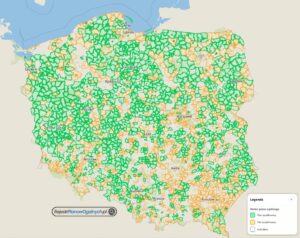
source: https://rejestrplanowogolnych.pl/ (accessed 20 October 2026)
It is also worth noting that a municipality’s preparation of a POG does not in itself constitute complete success. In many cases, plans are invalidated by provincial governors during the content review stage. This has affected, in particular, many of the first plans adopted, where municipalities rushed to prepare their POGs by the statutory deadline and made errors of varying severity in their content or in formal and technical matters. Provincial governors generally invalidate a plan where formal grounds exist, such as errors in planning zones, an incorrectly specified biologically active area, improperly designated infill development areas or technical errors in digital GML files. The mere adoption of a POG is therefore not yet a success: the document must also pass review at a higher level and must not contain irregularities requiring the provincial governor to invalidate it.
What does a municipal general plan contain?
A municipal general plan must specify planning zones and municipal urban planning standards and cover the municipality’s entire area. A municipality may also optionally designate infill development areas (OUZ) and inner-city development areas (OZŚ). It may select planning zones from a closed catalogue of 13 zones defined in the Act, which means that it cannot create zones with new names independently. Municipal urban planning standards define the functional profile and set development parameters, including the catalogue of functions permitted in a given zone and indicators such as maximum development intensity, maximum building height, maximum site coverage and the minimum proportion of biologically active area.
Infill development areas (OUZ) are areas within which a municipality may issue new decisions on development conditions. If a municipality does not include such areas in its general plan, as a rule no such decision may be obtained in that municipality. However, the fact that a property lies within an OUZ does not guarantee that a decision will be issued. The criteria set out in Article 61 of the Spatial Planning and Development Act and the requirements arising from the POG must still be met.
It should be emphasised that the local spatial development plan remains the implementing planning document within a municipality. The entry into force of a general plan does not invalidate existing local plans. However, every new local plan, as well as every amendment to an existing one, must fully comply with the general plan. The POG is the superior document and provides the framework for local plans.
Summary
Although the planning reform introduced by the 2023 Act may appear to be relevant primarily to local authorities, changing how they conduct spatial planning policy and prepare planning documents, a broader analysis shows that it has a real and tangible impact on most of society. To some extent, it changes the process for undertaking developments on privately owned property, depending on the property’s planning status. Depending on how actively a municipality adapts to the new statutory requirements, residents may encounter fewer or greater difficulties in pursuing new developments. The use of privately owned land may be subject to an entirely new framework, particularly where a property is not covered by a local plan and the municipality has not designated infill development areas in its newly adopted POG. Under the new rules, applications for decisions on development conditions for such properties have not been possible since 1 September 2026. The owners of such plots must wait for a new local plan, compliant with the general plan, to be prepared for the area. This situation was the principal cause of the flood of applications for decisions on development conditions submitted to public offices between 2023, when the reforming Act entered into force, and 31 August 2026. After that date, an application for a WZ decision can no longer be made where the municipality has no general plan.
The purpose of the current planning reform is to bring order to Poland’s spatial development by closing regulatory gaps and remedying the shortcomings of the previous spatial planning system. The new rules are intended to enable municipalities to develop in a more orderly manner while minimising uncontrolled suburbanisation, or urban sprawl. Municipalities are still preparing their general plans: more than half of local authorities have yet to produce such a document, while some adopted plans are being invalidated by provincial governors. This means that the reform’s transitional period may continue for quite some time and may cause difficulties for residents of individual municipalities until a general plan is adopted and enters into force.
[1] https://samorzad.infor.pl/wiadomosci/7670514,wiekszosc-gmin-weszla-we-wrzesien-bez-planow-ogolnych.html (accessed 20 October 2026)
[2] https://rejestrplanowogolnych.pl/ (accessed 20 October 2026)
Download report